You spot a brown spider darting across your floor and your first thought might be: “Is that a brown recluse or house spider?” You’re not alone. Many homeowners jump to that conclusion, especially when the spider looks tan or has long legs.
But here’s the truth: most “brown recluse sightings” in the Northeast turn out to be harmless house spiders. And even when true brown recluse bites occur, about 90% result in no reaction or a tiny self-healing lesion with roughly 10% developing dermonecrosis.
Knowing the difference between a true brown recluse and a common house spider helps you react calmly and take the right steps for your safety (and sanity).
Meet the Brown Recluse: Small, Shy, and Occasionally Dangerous
The brown recluse (Loxosceles reclusa) has earned its ominous reputation for a reason. Though it’s far less menacing than myths make it seem.
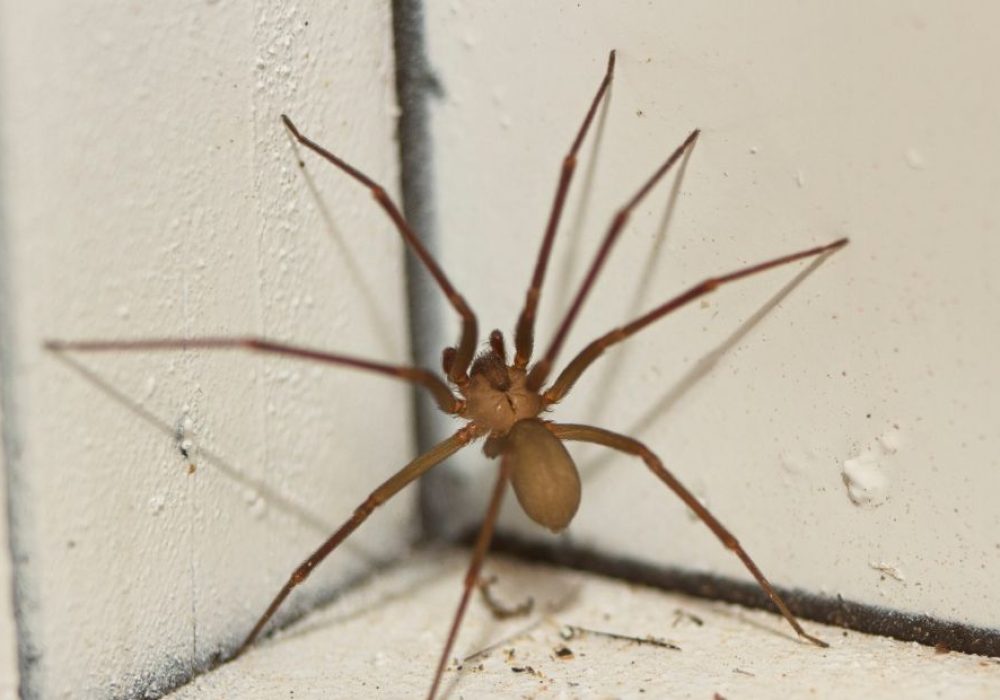
True to its name, it prefers to stay hidden. This spider measures about the size of a quarter, with long, thin legs and a distinct violin-shaped marking on its back.
Brown recluses are nocturnal and avoid humans whenever possible. They live in dark, undisturbed spaces like:
- Old boxes
- Basements
- Storage closets
Their bites are rare, but when they do happen, they can cause localized tissue damage that sometimes needs medical care. Still, most bites heal without major complications.
It’s also important to note that the brown recluse’s established range is primarily in the south-central U.S. (e.g., Missouri, Arkansas, Oklahoma, Texas), with rare, accidental introductions elsewhere.
Meet the Common House Spider: Harmless and Even Helpful
If you’ve seen a small brown spider spinning a web in the corner of your window or ceiling, chances are it’s a common house spider (Parasteatoda tepidariorum). These are the spiders most New England homeowners encounter.
House spiders build irregular, sticky webs in areas where flying insects are present in:
- Window sills
- Basements
- Near porch lights
While their webs can be a nuisance, these spiders actually help control other pests, including flies, mosquitoes, and even smaller spiders.
Unlike the brown recluse, the house spider is not dangerous to humans. They rarely bite, and even when they do, their venom isn’t medically significant. In short, they’re more of a sign your home offers good shelter and a ready food source than a reason to panic.
RELATED: How To Get Rid Of Spiders
Brown Recluse vs. House Spider: How to Tell Them Apart
Misidentification happens because both species are small, brown, and spindly. But when you look closely (or let a pest control in Manchester do it), the differences become clear:
| Feature | Brown Recluse | Common House Spider |
| Color/Markings | Uniform light to dark brown with a distinct violin shape on the cephalothorax | Varies — mottled brown, tan, or gray with no violin mark |
| Eyes | 6 eyes arranged in 3 pairs | 8 eyes in two rows |
| Body Size | About ¼ to ½ inch | Slightly smaller; legs may appear longer |
| Web Type | Dry retreats in hidden voids (not sticky traps) | Messy, sticky cobwebs in corners or near light |
| Behavior | Hides; avoids light and humans | Often visible in corners or windows |
| Geographic Range | South-central U.S.; rarely established in New England | Nationwide, very common in New England |
If you can safely observe the spider (without handling it), the violin marking and six-eye pattern are the best giveaways of a recluse. Take note that these details can be hard to see without magnification. When in doubt, it’s best to photograph the spider and contact a spider exterminator for identification.
Should You Worry About a Brown Recluse in New Hampshire?
Probably not. Brown recluses are not native to New England. Their established populations are limited to the Midwest and parts of the South.
Occasionally, isolated specimens may appear in northern states after hitchhiking in boxes or shipments, but they don’t tend to thrive in our climate. The Monmouth/Vetter distribution map shows their core range clearly outside New Hampshire (source).
That said, if you find a spider that fits the brown recluse description, it’s wise to have it checked. A free pest control inspection can confirm what you’re dealing with and ensure your home remains spider-free.
What to Do If You Find a Spider Indoors
Spotting a spider doesn’t mean you have an infestation. In fact, a lone spider often wanders in accidentally or is chasing prey. Here’s what to do safely:
- Don’t panic or squash it immediately. If possible, take a clear photo from a safe distance for identification.
- Avoid direct handling. Even harmless spiders can bite when trapped against skin. Use a jar or cup to catch it.
- Inspect and clean entry points. Check window frames, basement vents, and door gaps. Spiders sneak in through small openings.
- Reduce clutter and storage piles. Cardboard boxes, laundry piles, and stored items attract both spiders and their prey.
- Vacuum regularly and remove webs. This discourages spiders from rebuilding in the same area.
If you find multiple spiders or notice increasing activity, that’s when a professional inspection helps determine whether there’s a broader pest issue (like insects attracting them).
How MVM Pest Control Handles Spider Problems
At MVM Pest Control, a pest control Manchester, we understand that identifying and managing spiders can feel stressful, especially when you’re unsure what you’re dealing with. Our licensed pest exterminators know the difference between harmless house spiders and potentially concerning species.
We also offer:
- Cockroach extermination
- Commercial pest control
- Residential pest control
- Termite extermination
- Rodent extermination
- Bed Bug extermination
When you call us, we start with a comprehensive inspection to identify spider species, nesting areas, and contributing pest conditions. From there, we use targeted, eco-friendly treatments that eliminate spiders while minimizing risk to people and pets.
We also help you with long-term prevention: sealing gaps, reducing food sources, and recommending simple home maintenance to keep spiders (and other pests) from returning.
READ: Is Pest Control Worth Doing
Don’t Let Fear Spin the Web
Seeing a spider in your home can trigger instant alarm, but the odds of encountering a true brown recluse in New Hampshire are extremely low. Most likely, it’s a common house spider quietly doing pest control for you.
Still, correct identification matters and that’s where the experts at MVM Pest Control can help. If you’re not sure what’s hiding in your basement or corners, schedule a free professional inspection today.
We’ll confirm the species, eliminate the problem if needed, and make sure your home stays pest-free the safe, smart way.
Frequently Asked Questions
Are brown recluse spiders found in New Hampshire?
No. They’re native to the south-central U.S., and confirmed populations in New Hampshire are virtually nonexistent (distribution map).
Can house spiders bite humans?
Yes, but it’s rare and their bites are typically harmless.
How can I tell if a spider is dangerous?
Look for markings (like the recluse’s violin shape) and behavior. But since identification can be tricky, it’s safest to let a pest control expert confirm.
What should I do if I’m bitten by a spider?
Clean the bite area, apply ice, and monitor for swelling or pain. Seek medical advice if symptoms worsen or you suspect a venomous bite. For severity context, see the bite-outcome data from Penn State Extension linked above.